Use cases

What this looks like in a real business.

Not theory: real platforms running in real companies today, and the everyday situations they eliminate.

Live & running

A 10-person solar energy company (Spain)

Installations business · founder-led · growing customer base

Before

  • Client, installation and quote data scattered across dozens of spreadsheets
  • Critical knowledge trapped in a few people's heads, so every question went to the same people
  • Client communication fragmented across phones and inboxes
  • Every installation meant manual paperwork, filled in by hand, with errors

What we built

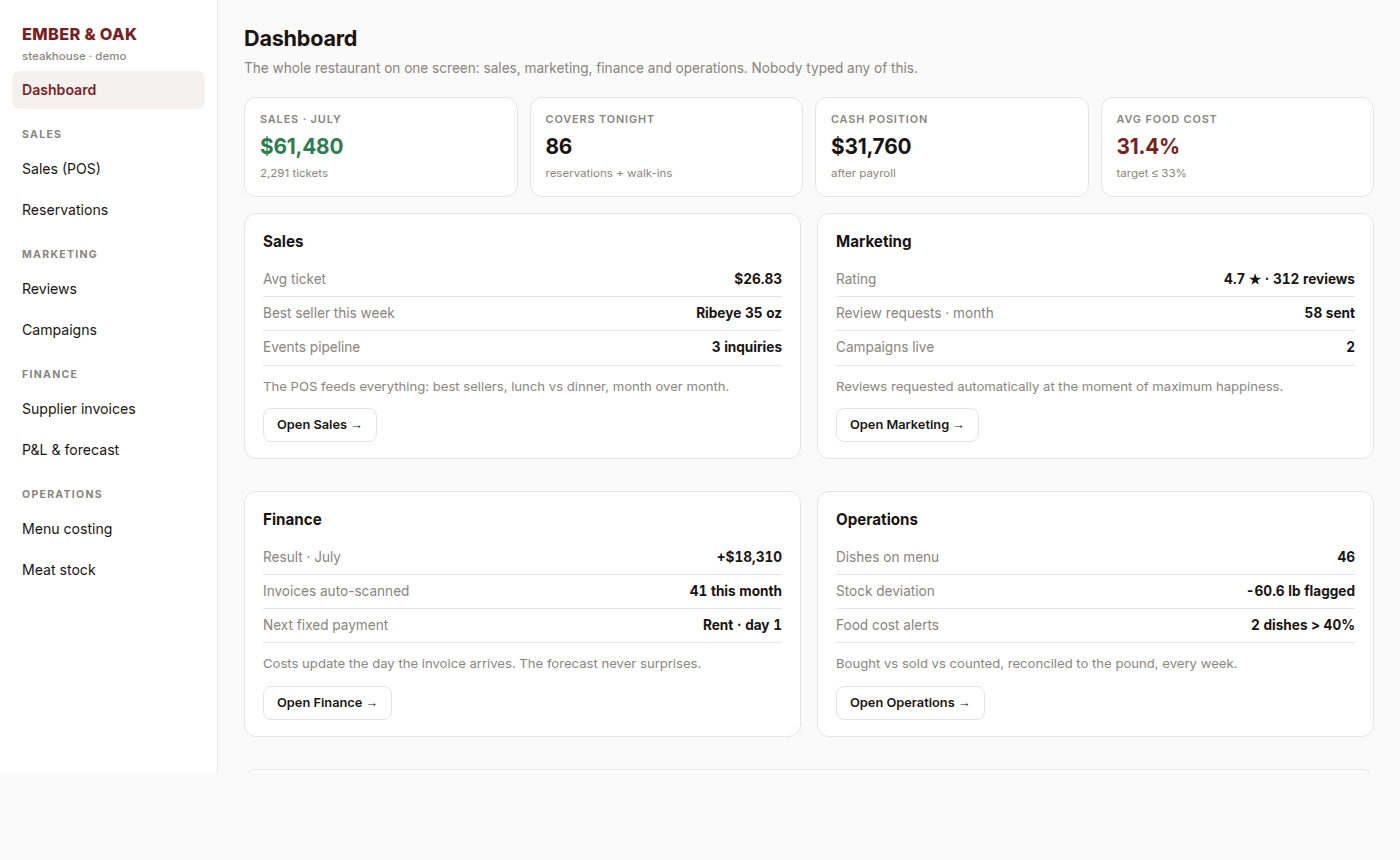
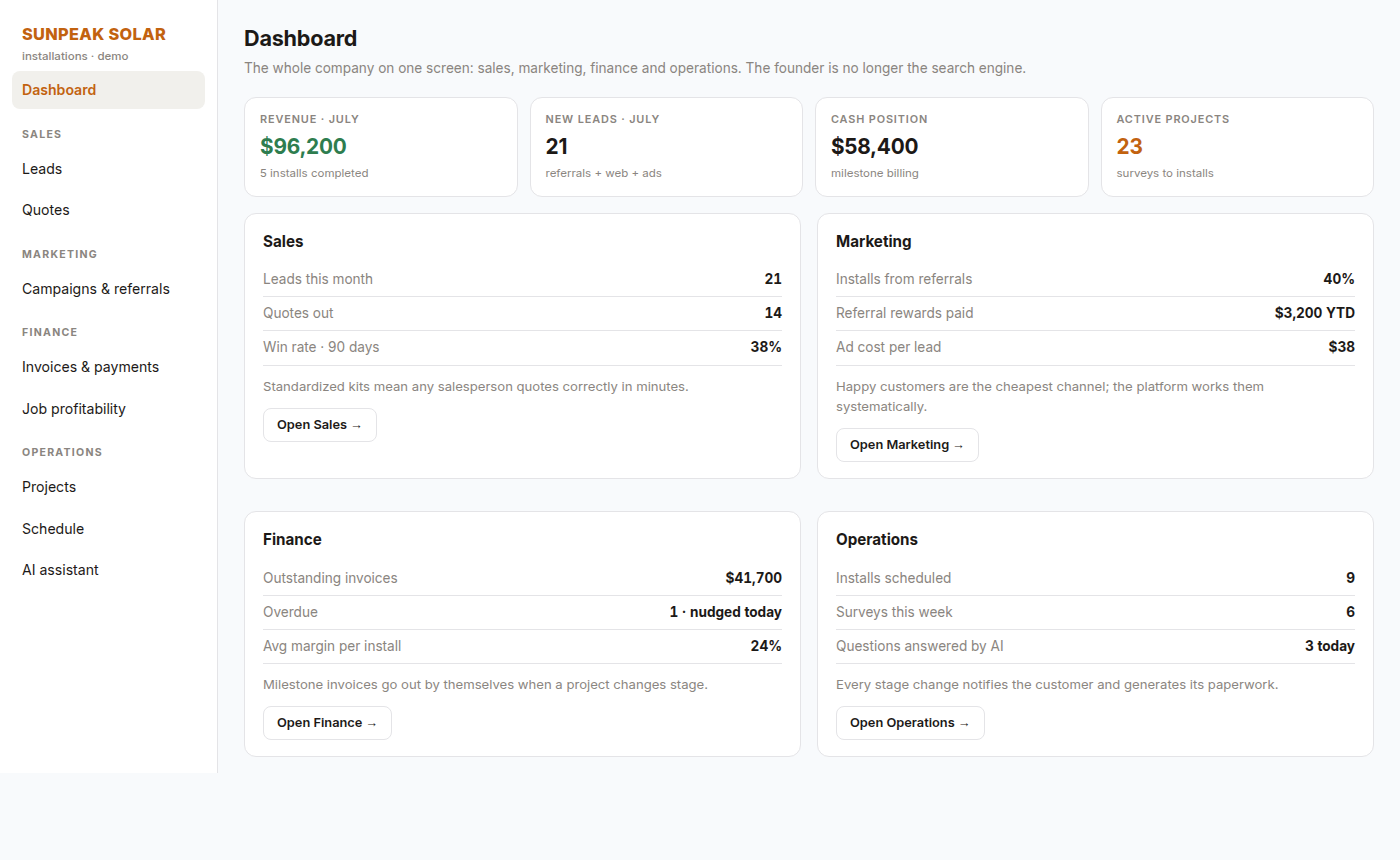
  • A centralized app that replaced every spreadsheet, with one database for clients, installations and quotes
  • An AI knowledge center that answers any employee's question instantly
  • Automated client communication at each stage of the job
  • Installation paperwork generated and pre-filled automatically
  • Automatic task assignment with shared team calendars

✅ Live and running today. Employees find answers in the platform instead of interrupting the founder. The founder is no longer the bottleneck.

Active engagement

A painting company (Pennsylvania, US)

Residential & commercial painting · founder-led · scaling fast

Where they started

  • High founder dependency: decisions, sales and operations funneled through one person
  • Manual operations and little marketing automation
  • Too many disconnected software tools, each with its own cost and learning curve
  • Information spread across systems, hard to find and impossible to report on

What we're building

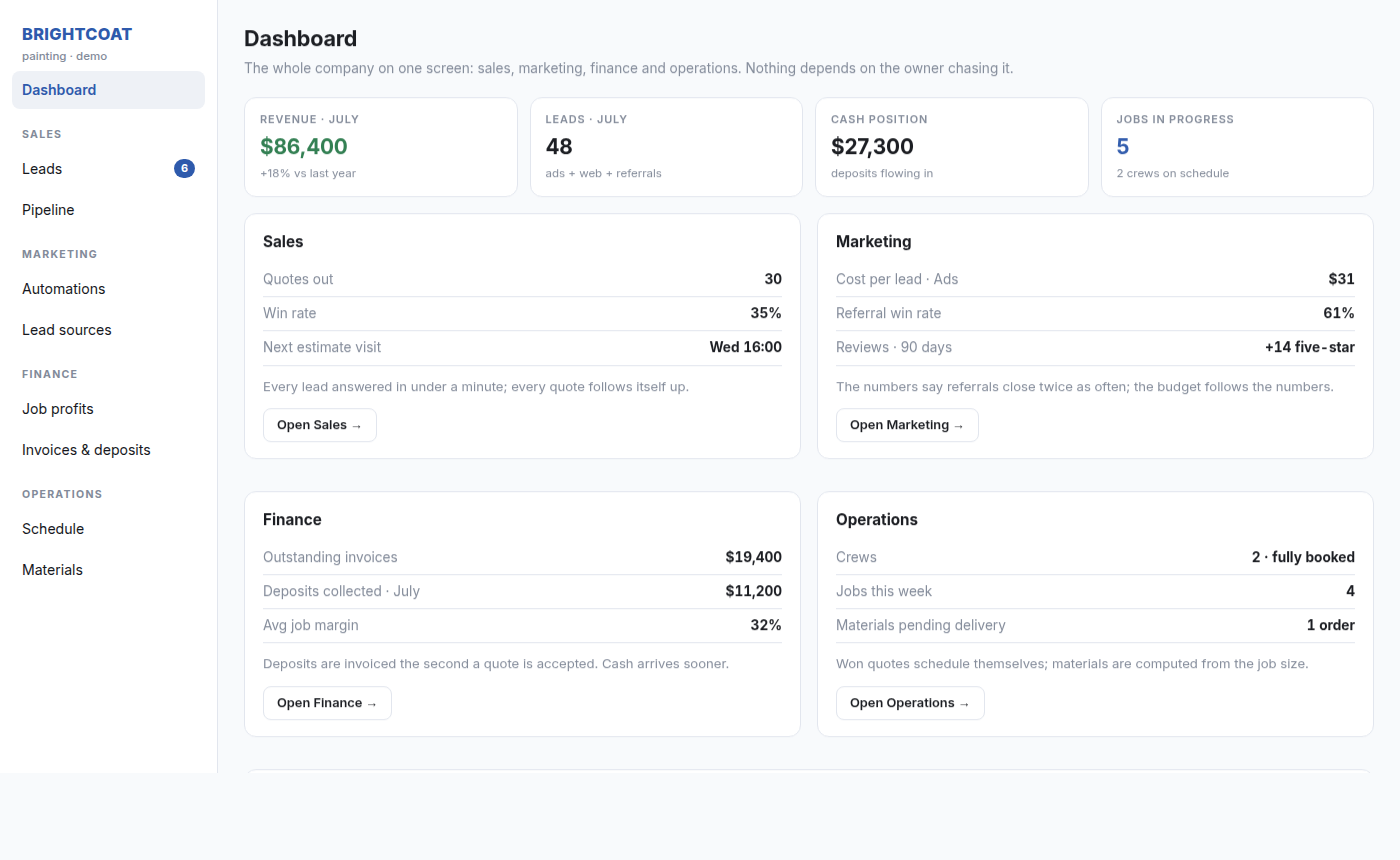
  • Automated lead generation and marketing workflows
  • An optimized sales pipeline connected to project management
  • A consolidated tool stack: fewer subscriptions, one source of truth
  • Documented processes and dashboards that show the real state of the business

🔄 In progress: a full-scope transformation with one goal: a company that grows without everything running through its founder.

Everyday scenarios

Situations every owner will recognize

Five stories we hear in almost every first conversation, and what changes when one platform takes over.

Knowledge

The owner who can't take a vacation

Every time you're away, your phone fills up: "Where's the quote template?" "What do we do when a client cancels?" "Which supplier do we call?" The business pauses because the answers live in your head.

One week off means fifty calls and a backlog of stalled decisions. Your team asks the platform's assistant and gets the same answer you would have given.
Knowledge · Operations

The key employee who quit and took the know-how with them

Your best person resigns, and suddenly nobody knows how invoicing really works, which clients need special handling, or where the passwords are. You spend months rebuilding what was never written down.

One resignation sets the company back six months. Every critical process lives in the platform with a clear owner, so a new hire is productive in weeks, not months.
Communication

The same question, asked fifty times a month

The same doubts circulate endlessly through private messages: pricing exceptions, how to handle a complaint, what was decided in that meeting. Decisions get made, forgotten, and re-made differently.

Answers are repeated one-to-one and lost by next week. Every decision is recorded and searchable: answered once, found forever.
Data · Automation

Ten tools that don't talk to each other

A CRM here, a project tool there, invoices in another app, marketing in a fourth. Getting one clear number, like how profitable last month was, means an afternoon of copy-pasting into a spreadsheet.

More software each year, less clarity, and rising subscription costs. A connected stack with dashboards: any number in seconds, tools you don't need retired.
Operations · Automation

Hiring another person just to absorb the chaos

Work keeps falling through the cracks, so the reflex is to hire. But the new person inherits the same undocumented chaos and adds coordination overhead on top. Costs grow faster than revenue.

Scaling means duplicating headcount, and margins shrink as you grow. Automation absorbs the repetitive work, and you hire for growth instead of firefighting.

Sound familiar?

These aren't personality flaws or effort problems. The problem is that nothing in the business is connected, and that has a fix.

Talk to us about yours
Is this you?

A quick self-diagnosis

If you check three or more of these, your business has a dependency problem worth fixing.

Book a free diagnosis call

A 30-minute conversation. No commitment, and you'll leave with at least one thing to fix.